Sightseeing
Layout of the town
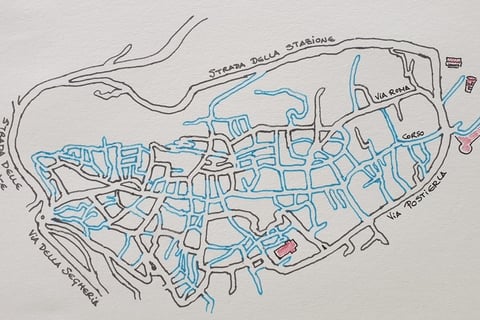
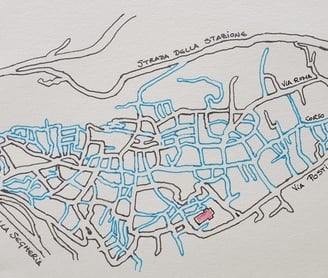
The cliff stretches more or less from east to west. The western part is the oldest. The Duomo is located on the middle axis, to the south, with the papal palaces next to it and today's tourist access to the nearby "Orvieto Underground", a part of the subterranean maze.
On the opposite side, towards the Eastern end, you can find Albornoz fortress, the barracks and the funicular arrival station.
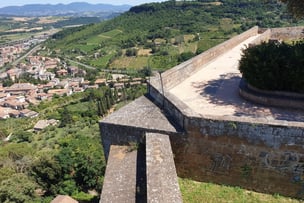
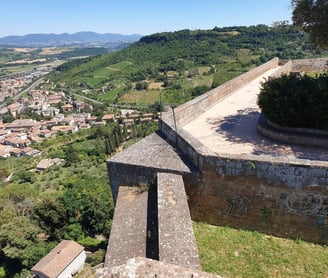
From East to West, Corso Cavour connects the funicular with Piazza Sant'Andrea, which some say was once the forum. It continues as Via Filippeschi and then Via della Cava again, crossing the medieval quarter and ending from the opposite top of the cliff, opening onto a small square with a lovely view over the valley.
Sights
The Cathedral
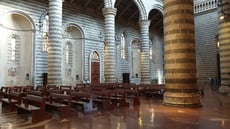
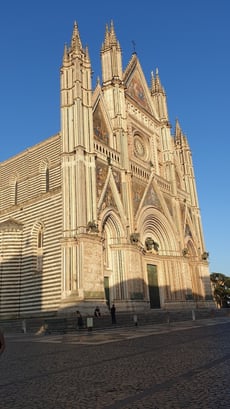
The magnificent cathedral is one of the finest examples of Italian Gothic architecture.
Construction started in 1290 under Pope Nicholas IV. Although the construction itself was completed within the first 40 years, it took 300 years to complete the entire complex including all of the interiors.
One of the most significant architects of the project was Lorenzo Maitani. As magister operas, he managed to pull in some of the most important artists and painters of the time. But the cathedral saw several additions until modern times, notably the massive bronze doors by Emilio Greco, who completed the new bronze doors in 1964.
The cathedral's façade, with its statues, gold reliefs and bas-reliefs from the fourteenth and fifteenth century that depict stories from the Old and New Testament, is amongst the most beautiful examples of Italian late middle ages.
It is worth visiting not only the cathedral itself, but also the adjacent museum.
[built 1290]
San Giovenale
[built 1004]
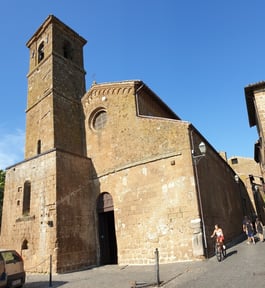
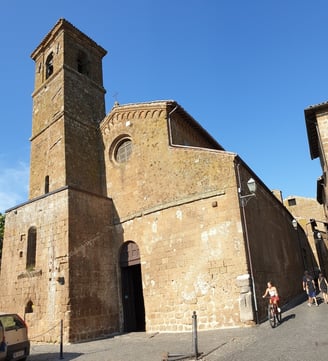
A truly wonderful little gem, built in 1004 on top of an even earlier church buidling from 6th century, and thus the oldest remaining church in Orvieto. Its predecessor was erected on the foundations of an ancient Etruscan temple, documented in an escavation of the late 19th century. Walls and columns still feature some of the original frescoes, heavily damaged through time but recently restaured. The church is sitting right on the edge of the cliff, so you have an impressive view over the entire valley.
From Via della Cava to Sant'Andrea: A dive into medieval Orvieto
Welcome to Via della Cava: the true heart of Orvieto, and the ancient center since Etruscan times. Unlike Roman towns, where life was organized around a centre, the Etruscan cities were built like a neural network: multiple centres served as meeting point and allowed exchange with strangers.
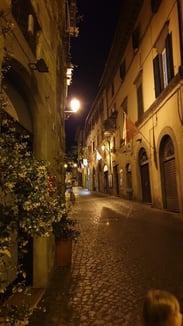
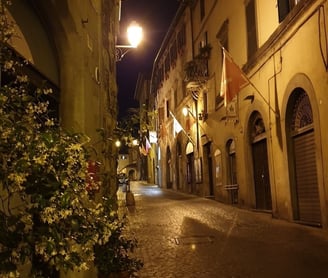
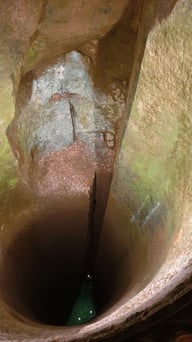
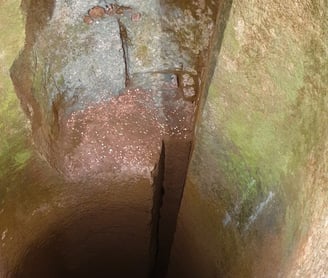
Following the Via della Cava, one can discover the most authentic Orvieto. Mulitple alleyways extend to the right and left from the Via della Cava, where one can explore the medieval centre.
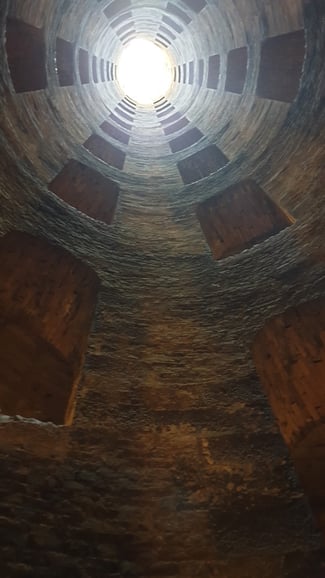
Take the time to visit the "Pozzo" (Via della Cava 28), a 2,200 year old well. Over the centuries, this well underwent many changes and extension.The entrance ticket allows you to access the extensive underground cave system located below the owner's restaurant.
Your descent will take you through the various historic stages, including Etruscan ponds, medieval wine cellars, and pre-industrial underground workplaces.
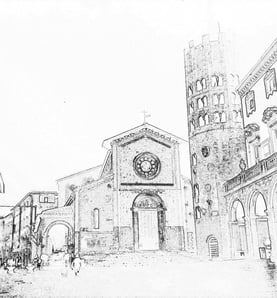
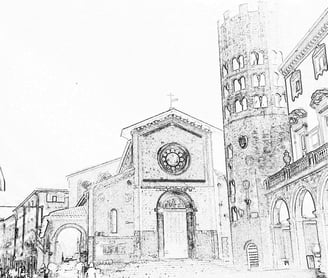
Taking the Via della Cava upwards, you arrive at Piazza della Repubblica and the church of Sant'Andrea. It is assumed that the square in front of the church was once the ancient forum of Etruscan Orvieto. Remains of an old Etruscan place of worship are are still visible inside the crypt.
Adriano's Maze
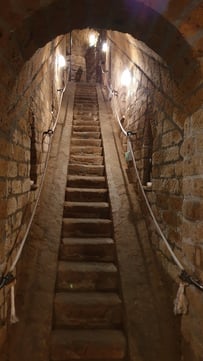
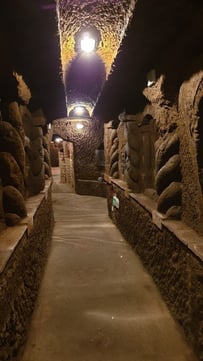
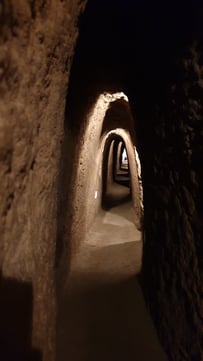
Another little gem and only relatively recently opened to the wider public: a vast underground network that was privately excavated by a local enthusiast. Along with the Pozzo della Cava, Adriano's Maze is one of the few places that allow visitors access to the underground city.
You have to make a reservation. A personal guide (usually a member of the family) will take you through the past 100,000 years of history documented in the system of caves underneath the family restaurant.
Torre del Moro & Piazza del Popolo
The Moor’s Tower ("Torre del Moro") is the city’s clocktower. It was originally built in the 13th century as a typical medieval tower house, but the ownership passed relatively quickly from the old Della Terza family to the pope. After this, it was known as the “Torre del Papa” (the Pope’s tower), even though the Church as early as 1300 passed it on to the city. But the name stuck until the 16th century, when Raffaele di Sante Gualterio, nicknamed “the moor”, became owner of the tower, the nearby palazzo (also named after him) and the streets surrounding it. The 47m high tower sits in the centre of gravity of the late medieval town, on the junction of the four cardinal lines along which the city’s four historic sections extend: Serancia, Corsica, Olmo and Stella. Climbing to the top, you can admire the historic bell of the Palazzo del Capitano del Popolo, cast in 1313 and transferred to the tower in 1876. The bell shows the 25 symbols of the Arts representing the most important guilds of the medieval city, as well as the people's seal.
San Domenico
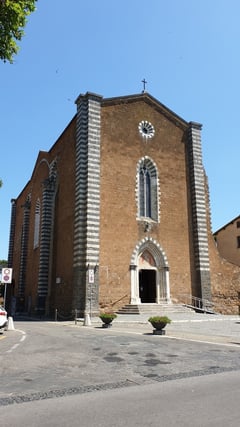
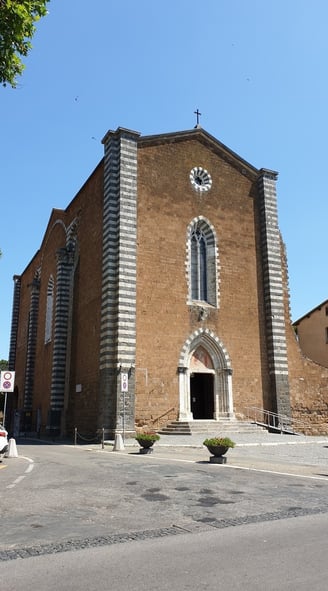
This fabulous little church features a zebra-striped pattern which was later picked up again by the architects of the Duomo. Construction started around 1235, which is only one year after Domenicus of Spain was canonized to be a saint. Little did they expect at the time that the order founded by S. Domenicus would become one of the biggest and most important medieval orders of the world. San Domenico of Orvieto is thought to be the very first Italian church dedicated to San Domenico, and the site did not only host the newly erected church in his name, but also a convent in which the growing order lived. The first chapter was held here 10 years later, in 1245. One of the most influential philosophers and jurists of the 13th century, Thomas Aquinas, came to Orvieto in mid 13th century to teach theology in this very convent over a period of 4 years. But though the order thrived, the church and convent have seen several setbacks. Indeed, what you see today is only what was originally one of the transept. The once massive nave, and the convent have been completely destroyed under the Fascist government. Also the original church lived through an unlucky history. At first, the new church was badly hit by a fire in 1311 which destroyed all of the roof, and had to be temporarily abandoned. The Dominicans returned quickly, but the building was yet again abandoned for a total of 20 years in late 14th century, for reasons unknown to us. It was then changed and remodeled to suit the fashions of time, and parts pulled down or altered substantially. Finally, in 1934, the Fascist government decided to plunder and strip down completely both nave and the convent, and built a girls' sport academy school on its site. Today, it has been transformed into barracks.Worth to mention the beautiful Monument to Cardinal Guillaume de Bray, built around 1282 by one of the finest masters at the time, Arnolfo di Cambio. It was only recently discovered that Arnolfo di Cambio used an ancient Roman statue that he transformed into a Madonna by slightly adjusting her features and adding a child of his own making.
The Fortress &
Pozzo di S. Patrizio